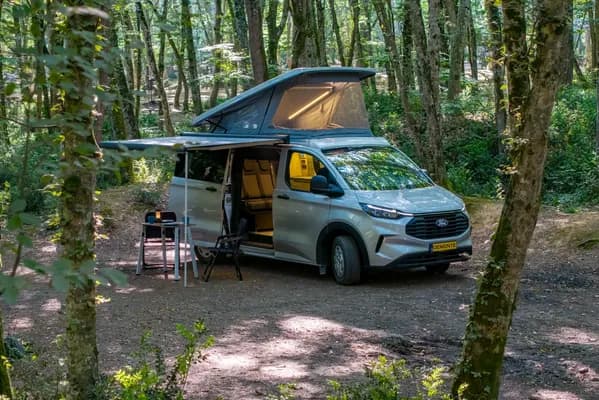
Anyone buying a campervan should have checked ten points before signing: registered seats, payload, registration as a motorhome, pop-up roof, energy system, heating, water, bathroom, drivetrain, and warranty and service. Most bad purchases come not from poor vehicles but from vehicles that do not fit the way their owner travels.
The list applies to new campervans and to converting a vehicle you already own. When buying used, add rust, damp damage and service history.
Which campervan suits me? Three questions first
- How many people travel, and how many sleep in the vehicle?
- Do you travel only in summer, or in frost too?
- Do you stay on campsites with a sanitary block, or often on pitches without one?
The answers determine layout, heating, water system and drivetrain, and with them almost every point on the list below. How different the answers can be is shown by our five layouts in the model overview: from the five-seater with four berths to the four-seater with a bathroom.
1. Registered seats, not just berths
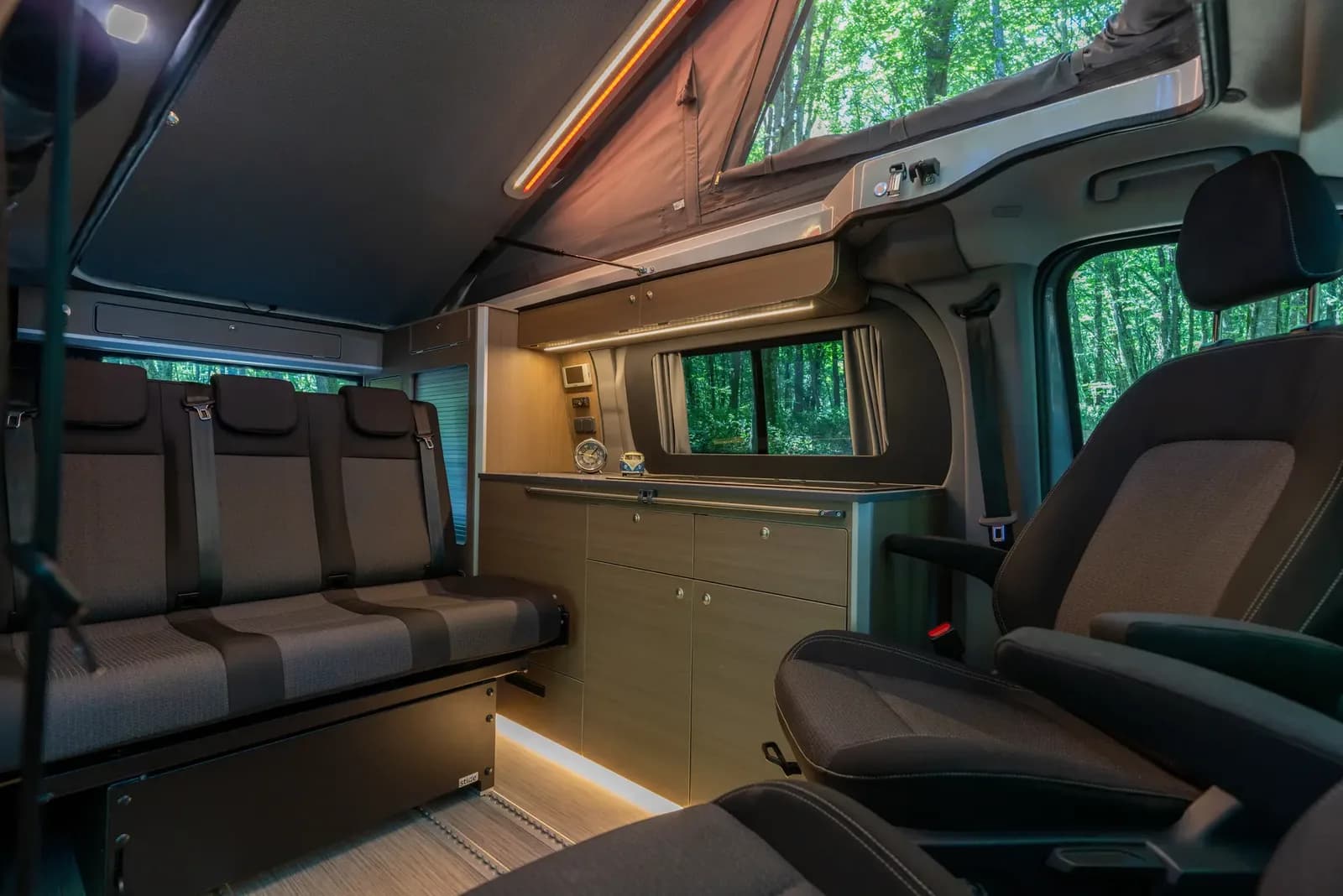
Berths appear in the brochure, seats in the registration certificate (Zulassungsbescheinigung). Only registered seats with a belt may be occupied while driving. A rear bench in the living area needs approval as a system of seat, belt and mounting.
Ask for the proof. Our Stide sliding seats are TÜV SÜD M1-tested and have passed ECE tests R14, R16 and R17; details on the rail-mounted seat benches page.
2. Permissible gross weight and real payload
A category B driving licence lets you drive vehicles up to 3.5 tonnes permissible gross weight, and campervans on the VW Transporter and Ford Transit Custom fall within that limit. What matters is what is left after the conversion: permissible gross weight minus unladen weight with a full tank gives the payload for people, water and luggage.
Ask for the weighed unladen weight of the finished camper, not the brochure weight of the base vehicle. How to keep a heavily loaded camper stable on the road is covered in retrofitting air suspension.
3. Is the camper registered as a motorhome?
Classification as a motorhome affects vehicle tax and insurance. The prerequisites are a permanently installed seating area with a table, sleeping accommodation, cooking facilities and storage space. Before buying, clarify whether the vehicle is already registered as a motorhome or who will take care of the inspection. The process is described in our guide to registering a van as a motorhome.
4. Pop-up roof: tested, registered, watertight?
A pop-up roof alters the bodywork and must be inspected and registered. Ask for the test certificate and open and close the roof yourself at the viewing. Our SCA roofs from Germany are TÜV-tested, open manually or electrically and provide a roof bed of 120 × 200 cm. What matters with the roof is set out under retrofitting a pop-up roof: cost and TÜV.
5. Energy: how long does the camper last without shore power?
The deciding figure is not the wattage of the inverter but how many days the camper lasts without shore power. Ask for three values:
- Battery: type (AGM or LiFePO4) and usable capacity in amp-hours
- Solar: panel output in watts and type of charge controller
- Inverter: only needed if 230 V appliances are to run on board
For comparison: our new-generation campers run on Victron Energy technology, that is an 800 W inverter, an MPPT solar charge controller and a 100 Ah AGM battery, plus a flexible 200 W EcoFlow solar panel. LiFePO4 and an integrated EcoFlow power station are optional.
6. Heating: diesel or gas?
A diesel air heater runs from the vehicle tank and needs no gas bottles. Under § 60 StVZO, a permanently installed LPG system has had to undergo a G 607 test (in German) every two years since 19 June 2025. We use Eberspächer diesel heaters with temperature and timer control that run independently of the engine. If you travel in winter, ask whether the heater also starts reliably in frost.
7. Water: tank size and winter-proofing
Check where the tank and lines are. Under the floor they need insulation, otherwise the season ends with the first frost. Our new-generation models have an 84-litre fresh water tank under the floor, optionally 40 litres of grey water, winter-proof insulated lines and a digital level display. What else counts in winter is covered in our guide to winter camping in a campervan.
8. Bathroom or no bathroom?
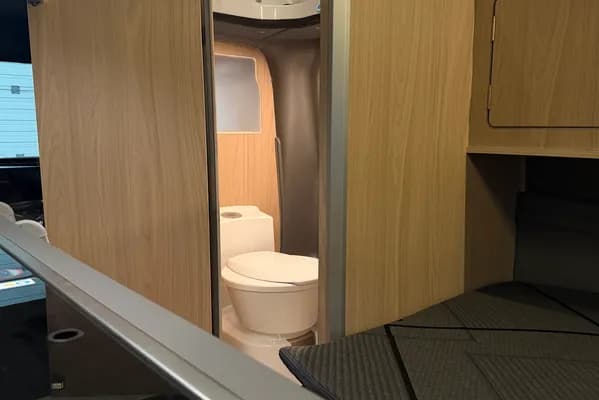
A bathroom with a cassette toilet and shower fits into a compact campervan only on the long wheelbase and costs a seat. If you often park without a sanitary block, you gain a lot; if you use campsites, you give up space for something rarely used. The trade-off in detail: campervan with a bathroom.
9. Drivetrain: front-wheel drive or all-wheel drive?
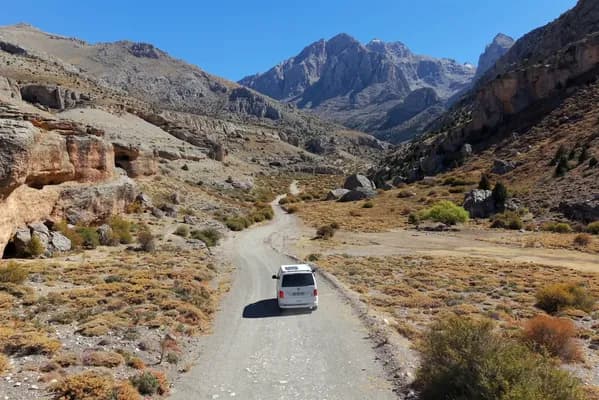
Front-wheel drive is enough for roads and made-up pitches. All-wheel drive pays off on wet meadows, gravel and snowy access roads, but costs payload and fuel and cannot be retrofitted later. More in 4x4 campervans: 4Motion or AWD. Whether VW or Ford makes the better base is answered by the comparison VW Transporter or Ford Transit Custom.
10. Warranty, service and handover
Ask about two warranties: the one from the base vehicle manufacturer and the one from the converter. A conversion that does not intervene in the chassis leaves the manufacturer warranty untouched. Our campers carry a two-year manufacturer and importer warranty.
Just as important is where the camper is serviced. Heater, roof bellows, seals and battery each have their own intervals. Demonte Caravan GmbH manufactures the furniture, electrical and water modules in Kocaeli and assembles, inspects and looks after the vehicles in Schwäbisch Gmünd; what we take on after handover is set out under after-sales, and appointments run through the service appointment form.
Handover should include an introduction to all systems, a handover record and complete papers: the registration certificate with the registered seats, test certificates for roof and seats, and the manuals for the heater and the energy system. Test every function yourself, from the roof and the bed to the pump and the fridge.
Buy new, configure, or have one converted?
- Finished camper from stock: the shortest wait. What is ready for handover right now is listed under in-stock vehicles.
- New base vehicle to your specification: through the custom vehicle order you choose body, drivetrain, colour and conversion in one pass.
- Conversion of your own Transporter: makes sense if you already own a suitable vehicle. Which items determine the price is covered in VW Transporter conversion costs.
Frequently asked questions about buying a campervan
Which driving licence do I need for a campervan?
For campervans on the VW Transporter or Ford Transit Custom, a category B driving licence is usually enough, because these vehicles are registered up to 3.5 tonnes permissible gross weight. What counts is the entry in the registration certificate. If you also want to tow a trailer, check the limits for the combination beforehand.
How many seats does a family with two children need?
At least four registered seats with belts, ideally five if grandparents or friends occasionally travel with you. Child seats may only be fitted on approved seats with suitable mounting. In layouts with a bathroom the number of seats usually drops to four; without a bathroom, five seats and four berths are possible.
What does a new campervan cost?
The price results from the base vehicle, wheelbase, drivetrain, pop-up roof, seating system, energy package, heating and, if fitted, a bathroom. Two quotes can therefore only be compared if it is clear which of these items they include. Ask for a quote with itemised line items instead of a single bottom line.
Should I buy a campervan new or used?
A used campervan is cheaper and available sooner, but carries risks around rust, damp and maintenance. A new camper offers a manufacturer warranty, current technology and a layout to your wishes. If you already own a used base vehicle in good condition, you can combine both and have only the conversion done new.
Does a campervan have to be registered as a motorhome?
No, but classification as a motorhome affects vehicle tax and insurance. It requires a permanently installed seating area with a table, sleeping accommodation, cooking facilities and storage space. The registration office enters the change after a testing organisation has inspected the vehicle. Clarify before buying which status is shown in the papers.
When is the best time to buy a campervan?
For a new camper or a conversion, autumn is a good time, so that vehicle, conversion and registration are complete by spring. If you only order in spring, you run into the demand at the start of the season. Finished vehicles from stock, on the other hand, can be handed over without a wait for as long as they are available.
Take the checklist into the quote
Go through the ten points before you compare quotes. If you have seats, payload, energy and heating in black and white, you compare vehicles instead of bottom lines.
Tell us how many people travel and when you are on the road. We will put together the right camper and itemise the quote line by line.
Get a quote