
Winter Camping in a Campervan: Heating, Water, Batteries and the Rules on the Road
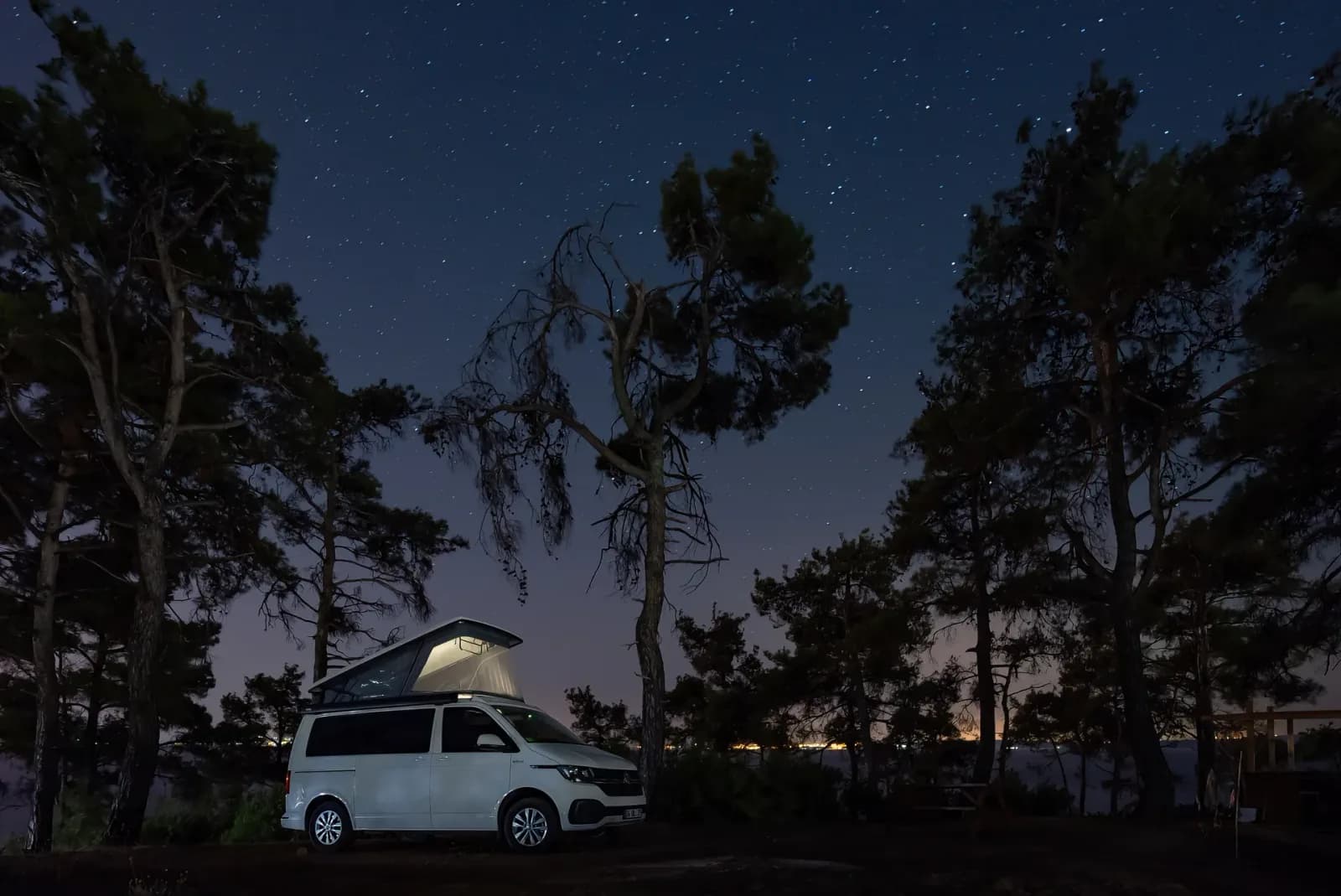
Winter camping in a van rarely fails because of the cold. It fails on four specific things: condensation, frozen water lines, a battery that does less in the cold than in summer, and a heater that either lacks output or needs constant refilling.
The good news: all four are solvable — but three of them are decided during the conversion, not on the pitch. This guide works through them in order.
1. Heating: diesel beats gas in winter
A diesel air heater fed from the vehicle tank is the more pragmatic winter solution for a simple reason: you are refuelling anyway. There is no cylinder running empty overnight, no change at minus five degrees, and no hunt for an exchange point abroad.
There is a physical argument too: butane barely vaporises at low temperatures. Heating with gas in winter demands pure propane — and even then the withdrawal rate drops in hard frost, especially from small cylinders.
Our models run an Eberspächer diesel air heater independently of the engine, with temperature and timer control from a digital panel. In practice that means setting the heater to start half an hour before you get up — the van is warm before you have to move.
- Have the heater serviced before the season; soot deposits in the burner are the most common failure at the first frost.
- Keep the intake and exhaust openings under the vehicle clear when parked in snow.
- Fill with winter diesel — summer diesel waxes in hard frost.
- Do not heat at maximum but hold a steady middle setting: it saves fuel and keeps humidity under better control.
2. Condensation: the real winter problem
Two sleeping people release roughly a litre of water into the air per night. In summer that leaves through open windows. In winter it condenses on the coldest surface in the vehicle — the glass, the corners behind the furniture, the bellows of the pop-up roof.
What actually helps:
- Leave the forced ventilation open. The instinct to seal everything up in winter is exactly wrong. Without air exchange, humidity rises until it reappears somewhere as water.
- Purge-ventilate twice a day. Two doors wide open for two minutes — the air changes quickly while the furniture and mattress barely lose their warmth.
- Thermal mats outside, not inside. Mats on the outside keep the glass warmer; mats on the inside create a cold surface with condensate behind it.
- Ventilate under the mattress. A slatted base or an under-mattress ventilation mat stops moisture collecting underneath — the classic source of mould in a van.
- Do not dry wet clothes in the living area. Every gram that evaporates lands on the nearest cold pane.
For the pop-up roof there is one more rule: retract the bellows dry wherever possible. If that is not an option, open the roof again on the next dry day to air it out. Wet bellows folds kept closed for weeks are the only load that genuinely ages a good roof.
3. Water: lines, tank and waste
Fresh water under the floor is ideal in summer and the critical point in winter. Our models therefore carry winter-proof insulated lines and a permanently installed underfloor tank with a digital level display — the display matters more in winter than in summer, because a half-full tank freezes through faster than a full one.
The rules that make the difference:
- Travel with the tank full rather than half full — more mass freezes through more slowly.
- For longer stops below freezing, drain the lines and pump rather than trusting the insulation.
- Do not let waste water accumulate: grey water freezes first, and a full frozen tank can no longer be opened. Leave the drain valve open into a bucket where the pitch allows it.
- Keep a drinking-water canister inside the heated cabin as a reserve, in case something freezes anyway.
4. Power: why the battery does less in winter
In winter the energy budget tips twice over: consumption rises (heater fan, lighting, longer nights) while solar yield collapses — low sun angle, short days, snow on the panel.
On top of that comes an effect many only notice in frost: LiFePO4 batteries must not be charged below 0 °C. The cell chemistry takes permanent damage, which is why good batteries have a BMS that blocks charging in the cold. That is protection, not a fault — but it does leave you without charge. Available capacity drops as well: at minus 10 °C to roughly 60 to 70 per cent of nominal.
Three routes get past this: a battery with integrated heating, installation inside the heated cabin — or an AGM battery, which also delivers less in frost but may be charged. Our standard specification is a 100 Ah Victron AGM with an MPPT solar charge controller; LiFePO4 is optional. For a vehicle that spends winter standing still, that order is no accident.
- Clear snow off the solar panel — even a thin layer takes the yield to almost nothing.
- Use shore power where it is available; in winter it is the more reliable source than the sun.
- Check consumption before adding capacity: the heater fan runs all night and is usually the single largest load.
How the energy systems in our vehicles are built — Victron technology, solar and the Octoopi control panel — is covered in our post on the VW Transporter camper conversion.
5. On the road: the Alpine symbol is mandatory
Germany has had a situational winter tyre requirement since 2010 under § 2 (3a) StVO: in black ice, packed snow, slush or frost, suitable tyres must be fitted. Since 1 October 2024 only the Alpine symbol (3PMSF) counts for this — the old M+S marking alone is no longer sufficient. Violations cost from 60 euros and a penalty point. The details are with the ADAC.
For a loaded camper two practical points follow. Snow chains do not fit every tyre and wheel combination — check that before you leave, not at the pass. And neighbouring countries have their own rules, some with a fixed calendar-based requirement rather than a weather-based one.
The van that works in winter
Three things are decided during the conversion and can hardly be retrofitted later: the heat source, the insulation together with the routing of the pipework, and where the battery sits. Everything else is equipment and routine.
If you are looking for a vehicle conceived for year-round use: the Ephesus is designed for four-season camping with hot water, heating and insulation, and carries a shower and WC on board; the Olympos brings the bathroom module on the long wheelbase. An overview of all layouts is under models.
Travelling in winter too? Tell us how and where — we will match the heating, insulation and energy system to it.
Get a quoteFrequently asked questions about winter camping
Diesel or gas heating for winter?
For winter camping a diesel air heater fed from the vehicle tank is more practical: no cylinder runs empty overnight and there is no change in the frost. Heating with gas in winter requires pure propane — butane barely vaporises at low temperatures.
How do I prevent condensation in a camper?
Leave the forced ventilation open, purge-ventilate twice a day for two minutes, fit thermal mats on the outside rather than the inside, ventilate under the mattress and do not dry wet clothes in the living area. Two people release around a litre of water into the cabin air per night.
How do I stop the water lines freezing?
Travel with the fresh water tank full rather than half full, drain the lines and pump for longer stops below freezing, and do not let the waste tank fill — grey water freezes first and a frozen tank can no longer be opened.
Can I charge a LiFePO4 battery in the frost?
No. Below 0 °C the cell chemistry takes permanent damage during charging; good batteries block it through their BMS. You need either a battery with integrated heating or installation in the heated cabin. Available capacity also falls, to roughly 60 to 70 per cent at minus 10 °C.
Which tyres are required in winter?
In wintry road conditions, tyres carrying the Alpine symbol (3PMSF) must be fitted. Since 1 October 2024 the old M+S marking alone is no longer sufficient; violations cost from 60 euros and a penalty point.
Can I use the pop-up roof in winter?
Yes, at moderate temperatures. What matters is retracting the bellows dry where possible and opening the roof again on the next dry day after a wet night. In hard frost and under snow load the roof is better left closed.