VW Transporter Camper Conversion: What Drives the Price and Which Systems Matter
The question “what does a VW Transporter conversion cost?” has no honest single-number answer — the price hangs on seven items, each decided separately. Knowing them is what makes quotes comparable at all. Not knowing them means comparing bottom lines that describe completely different vehicles.
This article walks through the seven items, names the quality criterion for each, and explains at the end why the order of the decisions matters more than the budget.
1. The base vehicle
Everything else follows from it. We build on two VW generations: the T5–T6 series (2016–2024) and the new Transporter (from 2024) — both in short and long wheelbase. Three questions decide:
- Wheelbase: short is more manoeuvrable and parks in town; long makes room for a galley and a washroom at the same time. Layouts with a bathroom exist on the long wheelbase only.
- Drivetrain: front-wheel drive is enough for roads and made-up pitches. 4Motion pays off when gravel, snow and meadows are part of your travel profile.
- Seats: the number of registered seats determines how many people may travel while driving — and that can only be increased afterwards with approved seat systems.
Which layouts we offer on which base is set out on the VW Transporter camper conversion overview; the two layout variants are Model C and Model G.
2. The roof
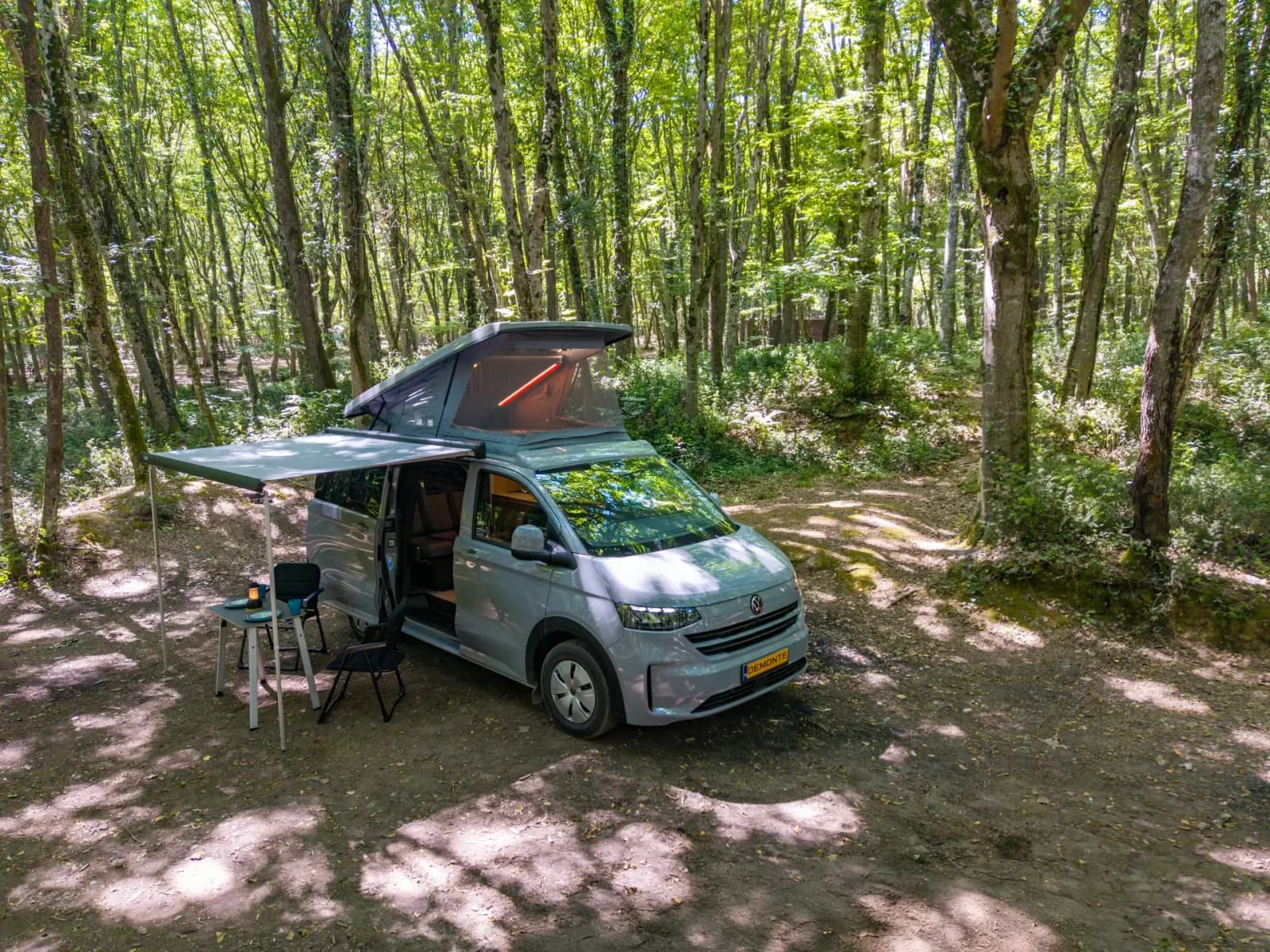
A pop-up roof is the largest single item after the vehicle and also the one with the biggest effect: standing height at camp plus a second sleeping area of 120 × 200 cm. Our roofs come from SCA in Germany, are TÜV-tested and open either manually or electrically. Costs, process and registration are covered separately in retrofitting a pop-up roof.
3. The seating and bed system
This is where a serious conversion separates from cabinetmaking. A bench that may be occupied while driving needs approval as a system of seat, belt and mounting. We fit Stide rail seats with M1 type approval and integrated belts; the systems have passed ECE tests R14, R16 and R17 and fold into a 130 × 190 cm double bed. Driver and passenger seats sit on swivel bases.
More on the rail-mounted seat benches product page. Why this is decisive for registration is covered in our guide to registering a van as a motorhome.
4. Energy
The point where most conversions fail in daily use — not because something breaks, but because the budget does not add up. Our vehicles run on Victron Energy technology: an 800 W inverter, an MPPT solar charge controller and a 100 Ah AGM service battery, plus a 220 V shore power connection with fusing and earthing. On the roof sits a flexible 200 W monocrystalline EcoFlow panel.
For longer off-grid stays there is an optional LiFePO4 battery or an integrated EcoFlow power station. Everything is controlled through Octoopi, our touchscreen panel: battery level, charging, solar yield, lighting, water pump and fridge on one screen.
The practical test question for any quote: how many usable amp-hours, how much solar, and what happens after three overcast days without shore power? A build that cannot answer with a number has not done the arithmetic.
5. Water and galley
Our current models carry a permanently installed 84-litre fresh water tank under the floor, optionally supplemented by 40 litres of grey water. Added to that: a pressure pump, a drinking-water filter, winter-proof insulated lines and a digital level display. In the galley, a Dometic combined hob and sink unit with a glass lid works alongside a 41-litre 12 V top-loading compressor fridge from Indel B.
The top-loader is a deliberate choice: cold air does not spill out when you open it, which saves noticeable energy on 12 volts.
6. Heating — and the gas question
We use an Eberspächer diesel air heater fed from the vehicle tank, running independently of the engine, with temperature and timer control from a digital panel. That has a side effect which is often overlooked: without a permanently installed LPG system, the G 607 gas test anchored in § 60 StVZO since 19 June 2025 — otherwise due every two years — does not apply.
7. Furniture and build quality
The furniture is made from lightweight, moisture-resistant plywood panels, CNC-machined. Weight is not a detail here but payload: every kilogram spent on cabinetry is missing later from water, luggage and passengers.
Manufacturing happens in our own production facility; conversion, assembly, technical inspection and quality control run at our site in Schwäbisch Gmünd. Processes follow ISO 9001, the electrical and plumbing components are CE-certified, and roof and seat systems are TÜV Süd approved. Details on the quality assurance page.
Tell us the vehicle, the wheelbase and how you travel — we will put together the right build and quote a price that reflects all seven items.
Get a quoteConvert your own, or buy a finished camper?
If you already own and love the Transporter, converting it is the obvious route. If you do not have a vehicle yet, a ready-configured model saves you time and an entire procurement step. From our current VW-based range: the New Cappadocia on the new Transporter, the Cappadocia with a 4Motion chassis and the Ephesus with a bathroom on board.
A third route sits in between: through the custom vehicle order you configure body, drivetrain, colour and conversion in one pass — vehicle procurement and build then come from one source. If you would rather leave straight away, our in-stock vehicles page lists the campers ready now.
What comes after handover
A conversion is not a furniture purchase but a technical system with service intervals: heater servicing, roof bellows and seals, water lines before winter, battery health. What we take care of is set out under after-sales; appointments run through the service appointment form.
Frequently asked questions about VW Transporter conversions
Which VW Transporter generations do you convert?
The T5–T6 series from model years 2016 to 2024 and the new Transporter from 2024, each in short and long wheelbase. Which seat layouts are possible depends on generation and wheelbase.
Does the vehicle warranty survive the conversion?
Yes. Our conversions do not intervene in the chassis or the original structure, and installation is carried out so that the original manufacturer warranty remains intact.
How many people sleep in a converted Transporter?
Four. The lower bed is formed from the rail bench and measures 130 × 190 cm; the pop-up roof opens to a second sleeping area of 120 × 200 cm.
Do I need 4Motion?
Front-wheel drive is enough for roads and made-up pitches. All-wheel drive pays off if gravel tracks, meadows or winter conditions are a regular part of your travel profile — on the Cappadocia the 4Motion chassis is the basis.
How long does a full conversion take?
That depends on specification, availability of the base vehicle and workshop capacity. We name a binding time window with the quote, once the vehicle and the scope are settled.
Is a gas system fitted in the conversion?
Our current models heat with an Eberspächer diesel air heater fed from the vehicle tank. Without a permanently installed LPG system, the recurring G 607 gas test does not apply.