
Retrofitting Air Suspension on a Motorhome: SemiAir, FullAir or Reinforced Springs?
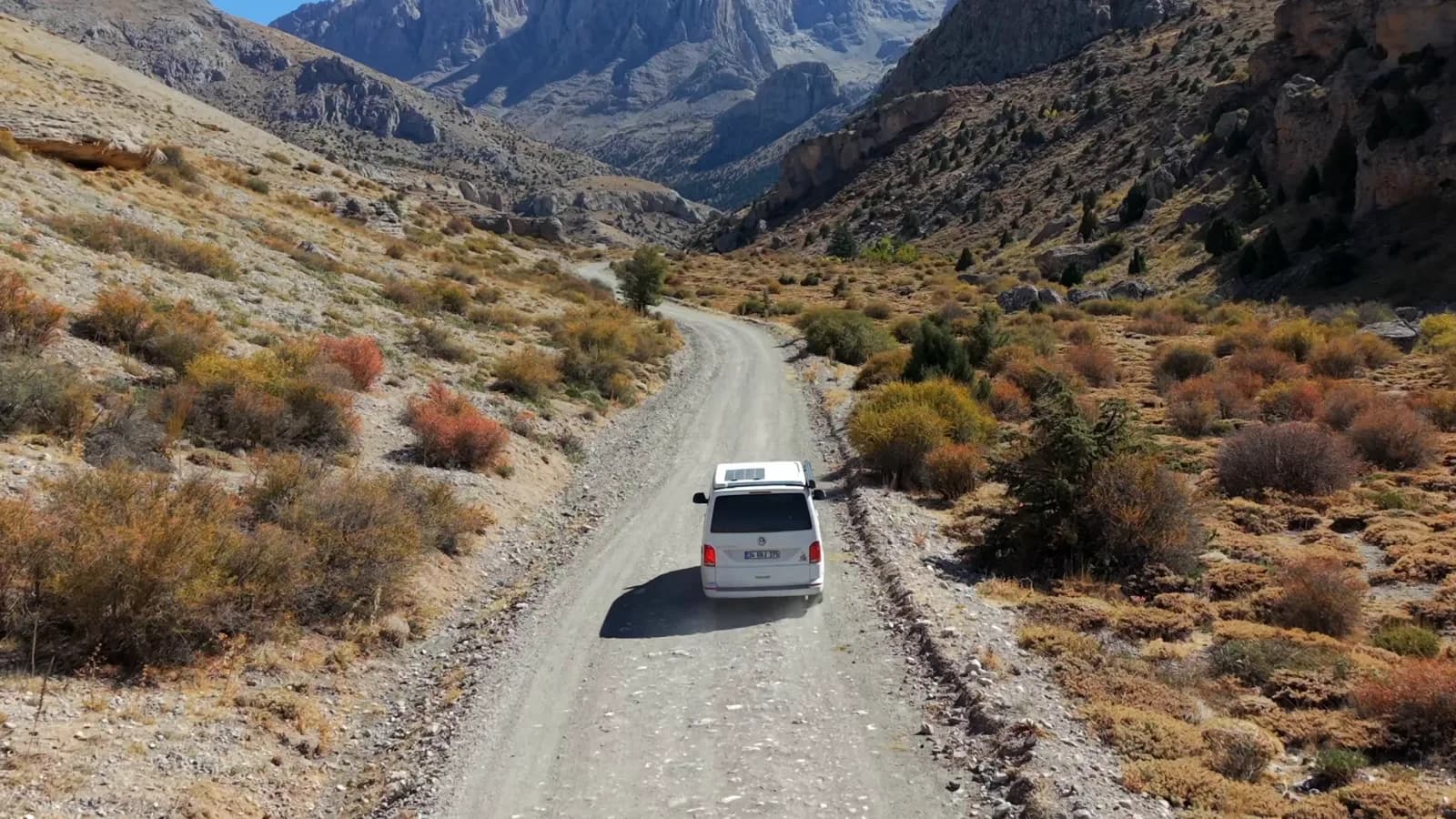
Rear-heavy, rolling through bends, twitchy in crosswinds, visibly lower at the back than the front: almost every converted panel van shows one of these symptoms once the water tank, furniture and luggage are on board. Retrofitting air suspension costs from around 1,500 euros for a simple single-axle system; a fully automatic set-up on both axles quickly reaches some 10,000 euros. The retrofit itself is usually done in a single day at the workshop.
The real question is not the price but which problem you want to solve — because the three families of systems do very different things.
Why a camper needs different springing
A panel van is engineered as a commercial vehicle: sprung for an empty load, loaded differently every day. A camper is the opposite — it travels permanently close to its maximum weight, and the mass sits in fixed places: furniture and bed at the rear, water tank under the floor, load on the roof.
Three effects follow, all noticeable on the first long trip:
- Rear-heaviness: the vehicle sits lower at the back, the headlights aim too high, the front axle goes light and steering loses precision.
- Body roll: a camper’s high centre of gravity amplifies lean in bends and roundabouts.
- Crosswind sensitivity: large side surfaces plus soft springing mean constant steering corrections — the main source of fatigue on long motorway stages.
The three families of systems
Our vehicles use systems from VB Air Suspension in the Netherlands, developed and tested to European standards. They cover three different approaches.
VB-SemiAir — semi-air suspension
On a leaf-sprung vehicle, a bellow is fitted between chassis and rear axle to support the existing leaf spring. The original springing stays and is supplemented. Air pressure can be adjusted manually within defined limits.
The construction is what matters: VB-SemiAir comes as a two-chamber system — the bellows are not interconnected. Left and right can therefore be set separately, and the vehicle stays level even under uneven loading. For rear-heavy conversions with a long wheelbase or a large rear overhang, this is the classic entry point.
VB-FullAir — full air suspension
Here the existing leaf or coil springing is replaced. The system takes over all springing work and consists of bellows, dampers, height sensors, a compressor and an electronic control unit (VB-ASCU). It regulates automatically, filters out road irregularities and allows the ride height to be adjusted — by more than ten centimetres, depending on the installation.
Cost and installation effort sit well above semi-air. In return it is the only solution that delivers levelling, comfort and adjustable ride height at once — useful on sloping pitches, low entrances and ferry ramps.
VB-CoilSpring — reinforced or replacement springs
The mechanical answer, without air. Two variants:
- Replacement spring: the original coil spring is removed and replaced by a reinforced one.
- Auxiliary spring: the original leaf or coil spring stays and is supported by a spring placed alongside it.
Both increase spring travel, improve stability, raise comfort to a degree and return the vehicle to its original ride height. Maintenance-free, no compressor, no electronics — for many campers the most sensible answer.
Anti-roll bars and dampers: often the bigger lever
Talking only about bellows overlooks the two components that actually work against roll. An anti-roll bar couples the vertical movements of the two wheels on an axle: body roll in bends decreases, and crosswind sensitivity falls with it. On vehicles with a high centre of gravity — that is, any camper with a pop-up roof and a roof load — a reinforced bar is particularly effective.
Reinforced dampers in turn absorb the vehicle’s movements against the road more effectively and return it to the correct ride height after every movement. Softly sprung vehicles feel more comfortable at first but keep a more restless contact with the road. For a heavily loaded motorhome, the firmer set-up is the safer one.
In practice the combination usually pays: an auxiliary air spring or reinforced spring against rear-heaviness, a reinforced anti-roll bar against body roll, firmer dampers against the after-bounce. Only together do they make a chassis that matches the weight.
What does the retrofit cost?
Simple auxiliary systems on one axle start at around 1,500 euros; a fully automatic installation on both axles quickly reaches some 10,000 euros. Fitting is usually completed within one day at the workshop. These ranges are confirmed by the PiNCAMP by ADAC guide.
Weigh the benefit honestly: for a vehicle moved three times a year for a week at a time, the reinforced spring is usually the right answer. For one that travels for months and regularly stands on uneven pitches, levelling pays for itself quickly — in driving safety and in less fatigue.
Which system for which vehicle?
- Leaf-sprung rear, clearly rear-heavy: auxiliary air spring (SemiAir) or auxiliary spring.
- Coil springing, vehicle sitting too low at the rear: reinforced replacement spring (CoilSpring).
- Tall body, lots of motorway, crosswind: reinforced anti-roll bar plus firmer dampers.
- Changing loads, sloping pitches, height adjustment needed: full air suspension (FullAir) with levelling.
The complete system overview with all VB ranges is on our air suspension system page. Which system suits your vehicle depends on the type of springing, wheelbase, axle load and loading profile — we work that out from the vehicle data.
Tell us the vehicle, model year, permissible gross weight and how your camper is loaded — we will tell you which suspension system makes sense.
Get a quoteBefore you retrofit: check the weight
Air suspension compensates for load — it does not raise the permissible axle load or gross vehicle weight. Anyone regularly driving overloaded fixes the feel with a bellow, not the legal problem.
So weigh the vehicle once fully loaded, with a full water tank and travel luggage. If little headroom remains, the real adjustment is the conversion itself — furniture weight, tank size and roof load. How those items relate to each other is covered in our post on the VW Transporter camper conversion.
Frequently asked questions about air suspension
What is the difference between auxiliary and full air suspension?
Auxiliary air suspension supplements the existing leaf or coil spring with a bellow that distributes the load better. Full air suspension replaces the series springing entirely and, with bellows, dampers, height sensors, compressor and control unit, takes over all springing work — including automatic levelling.
What does motorhome air suspension cost?
Simple single-axle systems start at around 1,500 euros. A fully automatic installation on front and rear axle reaches roughly 10,000 euros. Fitting is usually completed within one workshop day.
Does air suspension increase payload?
No. It distributes the load better and restores ride height, but changes nothing about the permissible axle load or gross vehicle weight. If you travel close to the limit, the answer lies in weight, not in springing.
What does a reinforced anti-roll bar achieve?
It couples the vertical movements of the wheels on an axle, reducing both body roll in bends and crosswind sensitivity. On vehicles with a high centre of gravity — campers with a pop-up roof and roof load — the effect is particularly clear.
Can I adjust the vehicle height with it?
Only with full air suspension. It allows the ride height to be adjusted, by more than ten centimetres depending on the installation. Auxiliary air springs and reinforced springs merely restore the original ride height.