
Registering a Van as a Motorhome in Germany: Requirements, Process and Costs
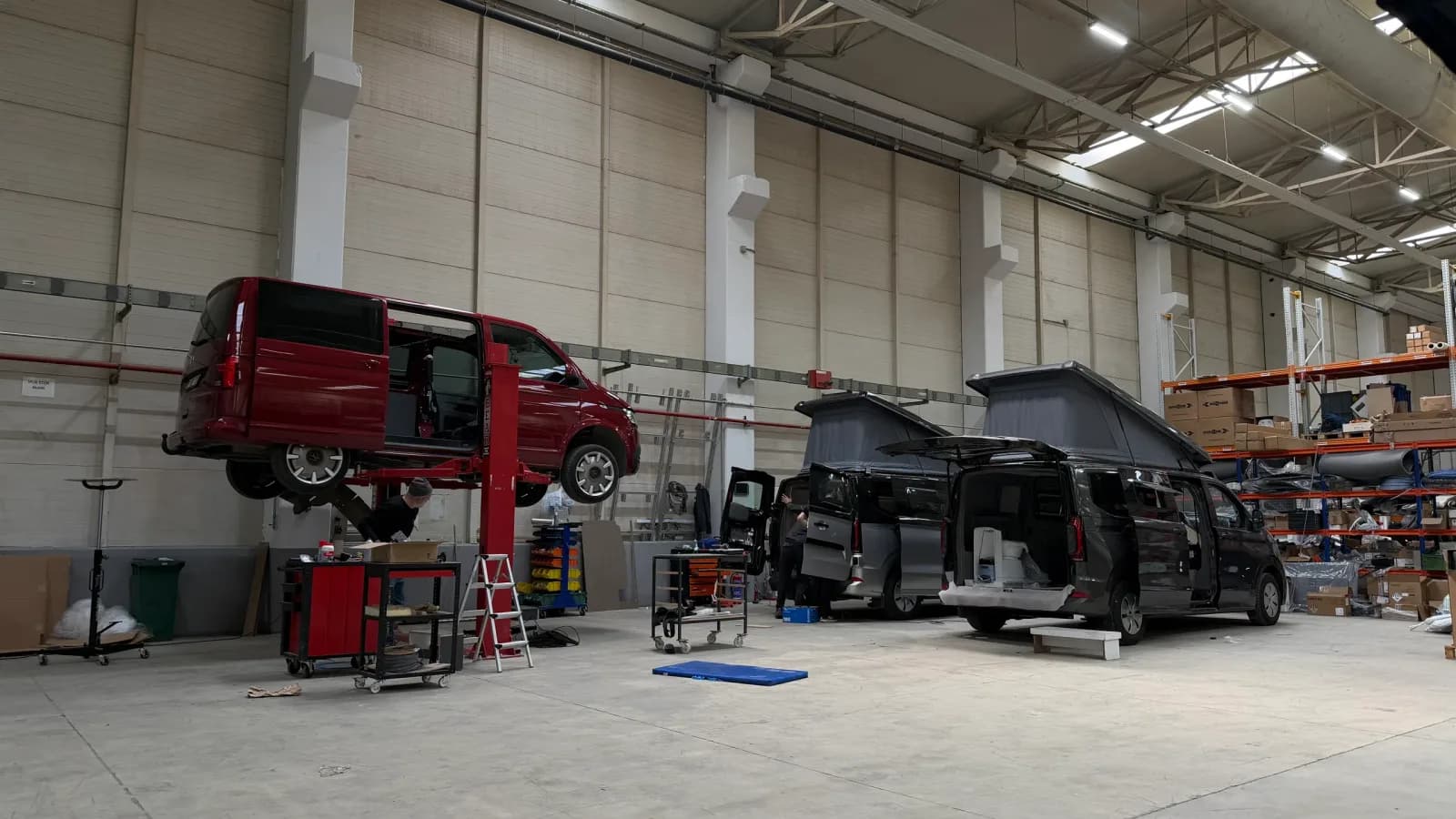
In Germany, “motorhome” is not a marketing term but a vehicle class. Before a panel van can be entered in the vehicle documents as a motorhome (Sonderkraftfahrzeug Wohnmobil), the Vehicle Registration Regulation requires five permanently installed features and an inspection by an officially recognised body. Planning this properly saves vehicle tax, often insurance too — and avoids the single most expensive mistake in the field: a finished conversion that fails its inspection.
This guide covers what is required, how the inspection works, what it costs and what to settle before you start building.
What legally makes a motorhome
The definition sits in § 2 No. 21 of the Vehicle Registration Regulation (FZV). What counts is not how much camping gear travels with you, but what is permanently attached to the vehicle. Loose camping furniture does not qualify. Required:
- Seating with a table: in addition to the driver and passenger seats; the table may be removable or foldable but needs a fixed mounting.
- Sleeping accommodation: a fold-down bench counts, provided it produces a sufficiently large, flat surface.
- Cooking facility: permanently installed — gas, diesel, spirit or electric. A portable camping stove does not count.
- Storage: lockable cabinets or secured compartments for luggage.
- Two independent escape routes: in practice usually a sliding door plus rear door, or a hinged window.
Every fitting has to be secured for driving. A cabinet that shifts under hard braking is not motorhome furniture, it is cargo — and the inspector will read it the same way.
Standing height: required or not?
A nationally mandated minimum standing height has not existed since 2012. The figure of 170 cm still circulates because individual inspection centres continue to expect it at the cooking area. Interpretation varies by region.
In practice: settle the expectation before you build, with the organisation that will inspect the vehicle. A pop-up roof answers the question elegantly anyway — it creates standing height at camp without changing the vehicle height on the road, and adds a second sleeping area.
The process: individual inspection under § 21 StVZO
Once the conversion is finished, an officially recognised expert (TÜV, DEKRA) or a technical service (GTÜ, KÜS) assesses the vehicle. The usual sequence:
- Book an appointment with the inspection organisation and describe the planned conversion in advance.
- Present the vehicle fully converted and roadworthy — temporary arrangements are not accepted.
- Provide documentation: reports and type approvals for the seats, belts, gas system and heater.
- Assessment under § 19 (2) in conjunction with § 21 StVZO; defects lead to a re-inspection.
- Take the report to the registration office, where vehicle class and body type are changed in the papers.
The most common reason for rejection is seats and belts. Benches in the living area may only be used while driving if seat, belt and mounting are approved as a system. Ready-made rail-mounted seat benches arrive with exactly that documentation: M1 approval and passed ECE tests R14, R16 and R17. A self-built bench does not.
What does registration cost?
The inspection itself is the smallest item. Budget realistically for:
- The individual inspection at a testing organisation — typically a mid three-figure sum, depending on the scope of changes.
- Re-registration at the registration office — fees in the low double digits.
- A G 607 gas test, if a permanently installed LPG system is fitted (see below).
- A re-inspection, should defects be found at the first appointment.
Exact rates differ by testing organisation and federal state — ask for an estimate for your scope when you book.
Vehicle tax: the real lever
Motorhomes are not taxed on engine capacity and CO₂ but on permissible gross weight and emission class, in increments of 200 kg. For emission class S4 and better: 16 euros per 200 kg up to 2,000 kg, then 10 euros per 200 kg above that, capped at 800 euros a year.
For a 3.5-tonne vehicle with Euro 6 the arithmetic runs: 2,000 kg gives ten steps at 16 euros (160 euros), the remaining 1,500 kg eight steps at 10 euros (80 euros) — 240 euros a year in total. The same van registered as a truck or a car costs a multiple of that, depending on the engine.
The full table by emission class is published by the ADAC in its overview of vehicle tax for motorhomes.
Gas systems: a separate test obligation since June 2025
Anyone fitting a permanent LPG system has carried an additional obligation since 19 June 2025: the G 607 test is anchored in § 60 StVZO and must be repeated every two years. It is not part of the periodic technical inspection but a separate appointment — the roadworthiness sticker is issued without a valid gas certificate, the fine for an expired one applies regardless. Details from the ADAC.
There is a way around it: no gas on board. A diesel air heater fed from the vehicle tank, plus an induction hob or a stove without a fixed gas line, makes the G 607 test unnecessary. That is the route our models take with their Eberspächer diesel heating and 12-volt compressor fridge — one recurring appointment fewer, permanently.
Self-build or professional conversion?
Both routes lead to registration. They differ in who carries the burden of proof.
Self-build
You buy each component separately and collect the corresponding reports yourself. It works — but it costs time, and individual parts are hard to get approved without system-level documentation for seats and belts. Some work is off the table anyway: a pop-up roof opens and reinforces the load-bearing roof skin and belongs in a certified workshop.
Conversion by a specialist
Here the vehicle arrives as a planned system. At Demonte Caravan the furniture, water and electrical modules are built at our own production facility and installed, inspected and handed over at our site in Schwäbisch Gmünd — under ISO 9001 processes, with TÜV Süd approved roof and seat systems and CE-certified electrical and plumbing components. The process is described on our quality assurance page.
If you have not settled on a base vehicle yet: we convert the VW Transporter, the Ford Transit Custom and the Fiat Ducato. Which conversion levels exist and what separates them is broken down in our post on the VW Transporter camper conversion.
Planning a conversion and wondering which layout suits your vehicle? Tell us what you have in mind and we will come back with a concrete assessment.
Get a quoteThe market agrees with you
The German used market for leisure vehicles set a record in 2025 with 192,239 ownership transfers, 111,034 of them motorhomes. Among new registrations, private motorhome registrations rose 7.2 per cent. The figures come from the CIVD annual report. A properly registered motorhome is therefore not only cheaper to run but also markedly easier to sell on.
Frequently asked questions about motorhome registration
Does a camper conversion need a full type approval?
As a rule an individual inspection under § 19 (2) in conjunction with § 21 StVZO is sufficient: the changes are assessed and entered in the vehicle papers. A full approval only becomes necessary when the chassis or body is altered so deeply that the original operating permit lapses.
Does my camper need 170 cm of standing height?
No nationwide minimum standing height has applied since 2012. Individual inspection centres may still expect it at the cooking area. Settle this with your testing organisation before you build — or solve it with a pop-up roof.
May passengers travel on the bench in the living area?
Only if seat, belt and mounting are approved and registered as a tested system. Seat systems with M1 type approval and passed ECE tests R14, R16 and R17 carry that proof; a self-built bench without documentation cannot be used as a travelling seat.
How much vehicle tax does a 3.5-tonne motorhome cost?
At emission class S4 or better it is 16 euros per commenced 200 kg up to 2,000 kg and 10 euros per commenced 200 kg above that. For 3,500 kg that gives 160 euros plus 80 euros, roughly 240 euros a year. The annual maximum is 800 euros.
Do I need a gas test if no gas is fitted?
No. The obligation under § 60 StVZO applies only to permanently installed LPG systems. Vehicles with diesel air heating and a gas-free galley need no G 607 test.